


Steps for Change
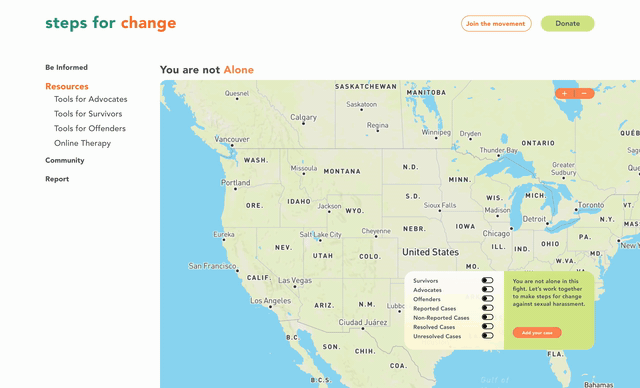
During my time at UNT, I worked alongside Olivia Moten and Amanda Griffith on our design portfolio project, Steps for Change. The product is an interactive website aimed at reviving the movement against sexual harassment by educating, connecting and guiding survivors, advocates and offenders towards positive change. Users can utilize resources to find out more information on sexual harassment, report an incident or institution and find out what is and isn’t appropriate. Users learn how they can positively affect their environment, explore a blog that centers around recovery, and connect with the community. Our work was nominated for UXDA's New Talent award, an honor to be considered by a jury from International Design Center Berlin (IDZ) against applicants across the globe.
Role
UX Designer, UX Researcher, Information Architect
Date
Jan 2020 - May 2020
DiscoveR
How did we come to this concept?
We were tasked with evaluating what S.T.E.E.P. candidate (social, technical, economic, ecological, and political factor) we wanted to focus on for the duration of the semester. When coming to a decision, we had considered the topics of data selling, student loan debt, and sexual harassment.
Why?
Everyone has a right to work or learn in a space of which they feel safe and comfortable. In accordance with this, if ssomeone feels they are being harassed, they should have easy access to report it without worries of retaliation.
While many companies have required sexual harassment training, what can we do to make sure people are abiding by these standards and how can we foster a community where people can gather to support one another who has faced these kinds of ordeals?
The lasting impact
Sexual harassment affects not only the one being harassed, but also:
-
The environment in which they work and/or learn
-
The way they perceive and trust other people
-
How other people may act towards them
-
How they may act with those closest to them
There has been strong support for movements such as the #MeToo movement, which was created to raise awareness for sexual harassment and sexual assault.
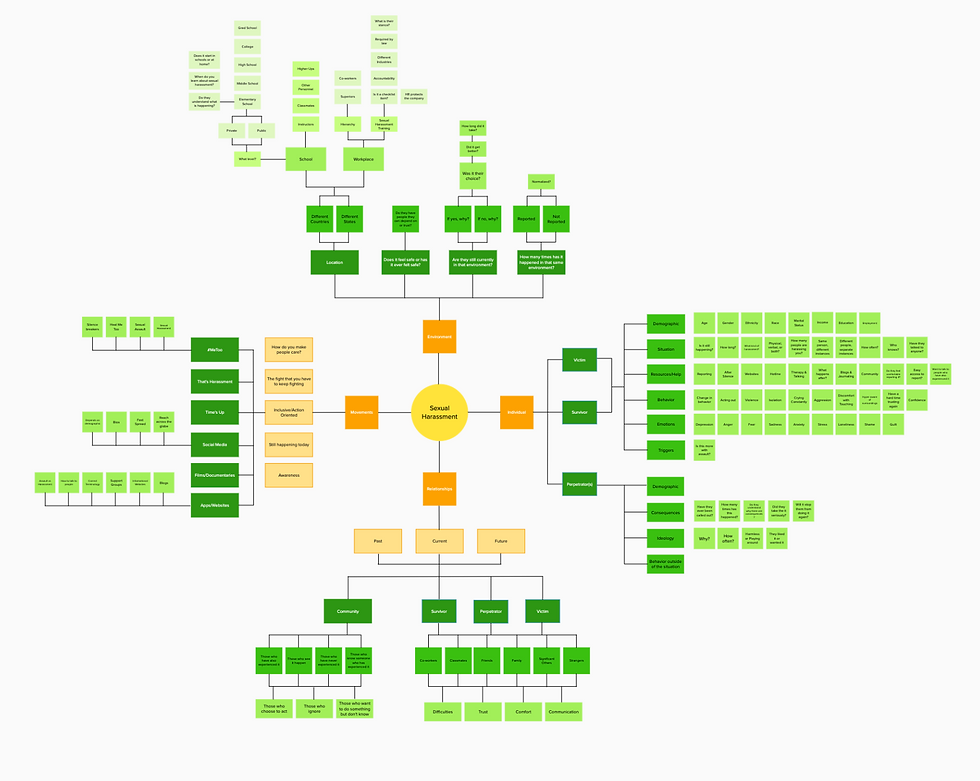
Problem Ideation & Decision Tree
-
Location (Domestic vs International; School vs Workplace, etc.)
-
Does it feel safe? Or has it ever felt safe in that environment?
-
Is the individual still in that environment currently?
-
How many times has an incident occurred in that environment?
Environment
-
Type of Individual in reference to sexual harassment
-
Demographic, Situation, Resources/Help,
-
Behavior, Emotions and Triggers
-
Consequences, Ideology, and Behavior outside of the situation
Individual
-
Co-workers, Classmates, Friends, Family, Significant Others, Strangers
-
Individual who has experienced harassment
-
Individual who relates and has also experienced harassment
-
Individual who sees and/or lets it happen
-
Individual who intervenes to stop it
-
Individual who has never experienced it
-
Individual who knows someone or of someone who has experienced it
Relationships (Past, Current, Future)
-
How do you make people care?
-
The fight you have to keep fighting
-
Inclusive/Action-Oriented
-
Still happening today
-
Awareness/Outreach
-
Community Involvement
Social Movements
DEfine

Personas
Our design team created personas for each of our three user groups: survivor, advocate, and offender. Creating these personas allowed us to hone the goals and user flows for our interactive website.
-
Understanding that offenders may not know why their actions are offensive or inappropriate and tackling that root issue
-
Advocates feel like they have difficulty having productive conversations with peers and are unsure the best way to help their friends
-
Insights on specific scenarios that survivors may stem from and why people may not report their cases such as insensitivity from institutions and a lack of productive action by law enforcement.
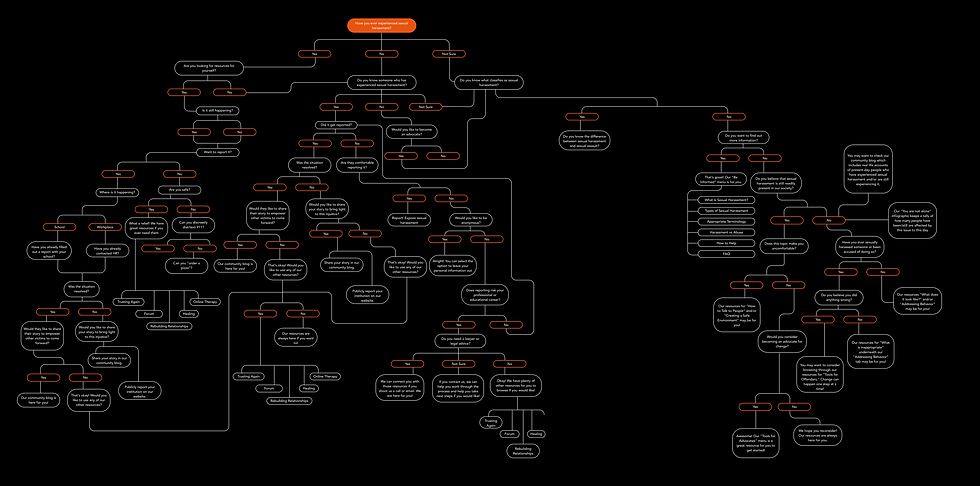
User Flow Map
What steps can the user possibly take and how does that relate to our site?
-
Looking for therapy resources to talk to a professional, but sometimes can’t afford it
-
Want to talk to other people who understand or relate to what they’ve went through
-
Want to move on with their life but also get justice or resolution
-
Wanting to help incite change and reform for societal progress

Cardsort & Tree-jack Testing
What are users looking for and how do you organize the navigation for smooth usability and easily found information?
-
If you were an offender, where would you go to take the quiz, “What is and isn’t appropriate?”
-
Take the quick assessment in our online therapy resource in order to find your therapist matches
-
If you were an advocate, find the information on how to speak out against sexual harassment.
-
If you were an advocate, find the information on how to speak out against sexual harassment.
-
If you were an offender, where would you go to take the class, “What is Sexual Harassment?”
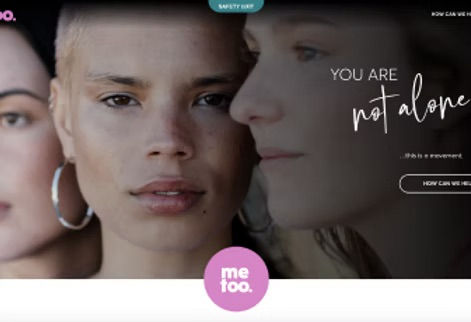
Competitive Analysis
What are competitors doing well and what are they lacking? (#MeToo and RAINN)
-
Social media presence and visibility
-
An abundance of resources for survivors and advocates
-
Lack of resources to educate offenders
-
Text-heavy and hard to take everything in all at once

Information Architecture
Based off of the findings from our card sort and treejack testing, we were able to generate and validate a propoed first round of navigation.
-
Separated into 4 categories:
-
Be Informed
-
Resources
-
Report
-
Community
-

Empathy Maps
The team then created empathy maps for both a victim and a perpetrator of sexual harassment. The empathy maps gave us insight into the types of perpetrators and where these issues could be stemming from, but also how internal thoughts can affect the ability for people to reach out for resources, support, and health.
IDEATION
01
Wireframing
We spent extensive time focusing on if our wireframes flowed smoothly in black and white. Things should be easily understood and sectioned out well without the additional use of color at this stage.

03
Iconography & Logo
We decided to create a modular logo, showing that "steps for" could stay consistent, but allowed us to replace the last word with other mission statements to support our cause, such as steps for changing stigma, steps for rebuilding relationships, etc. It was also important to us to make it feel human, choosing to incorporate a handwritten script instead of all type.

02
Style Guide
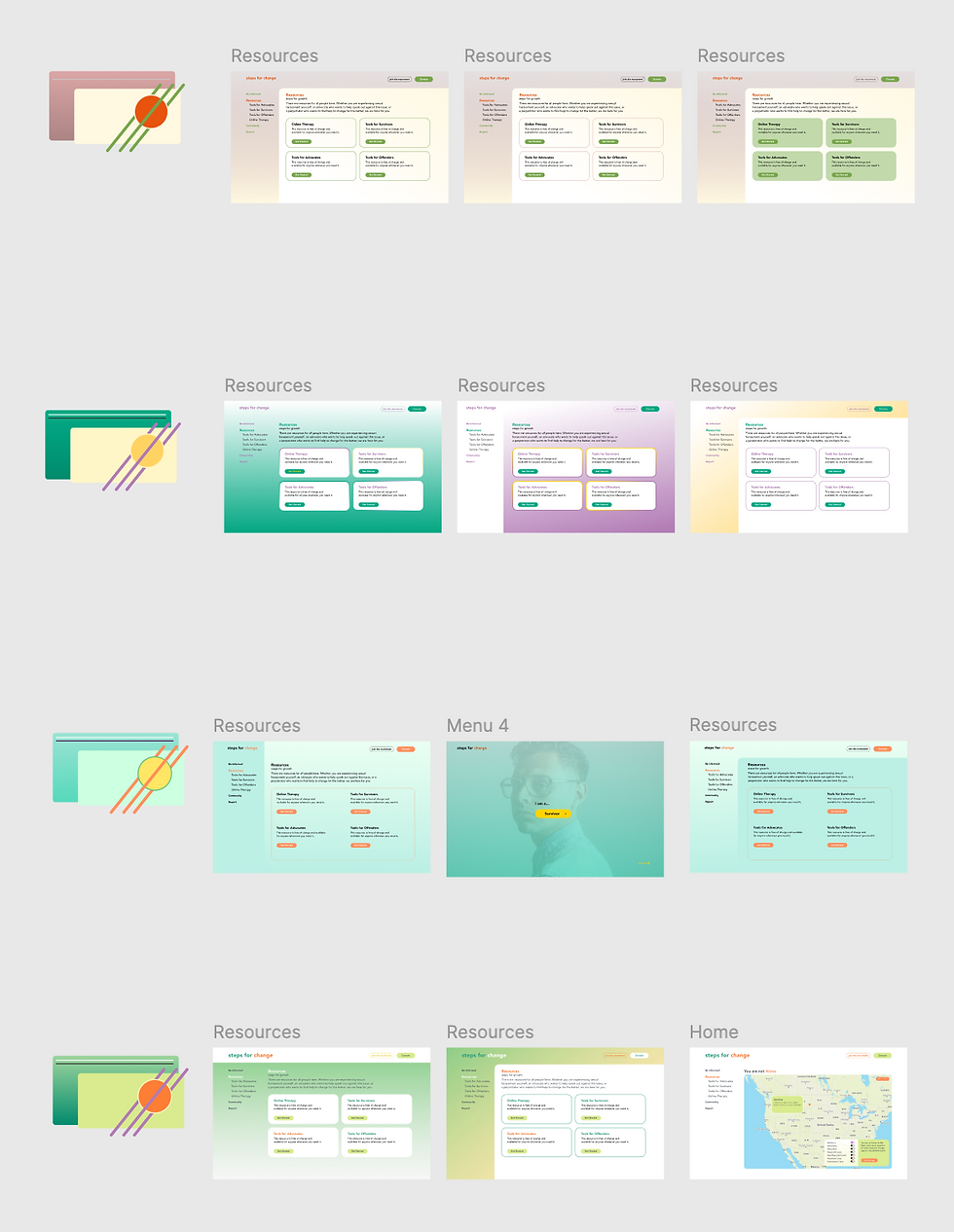
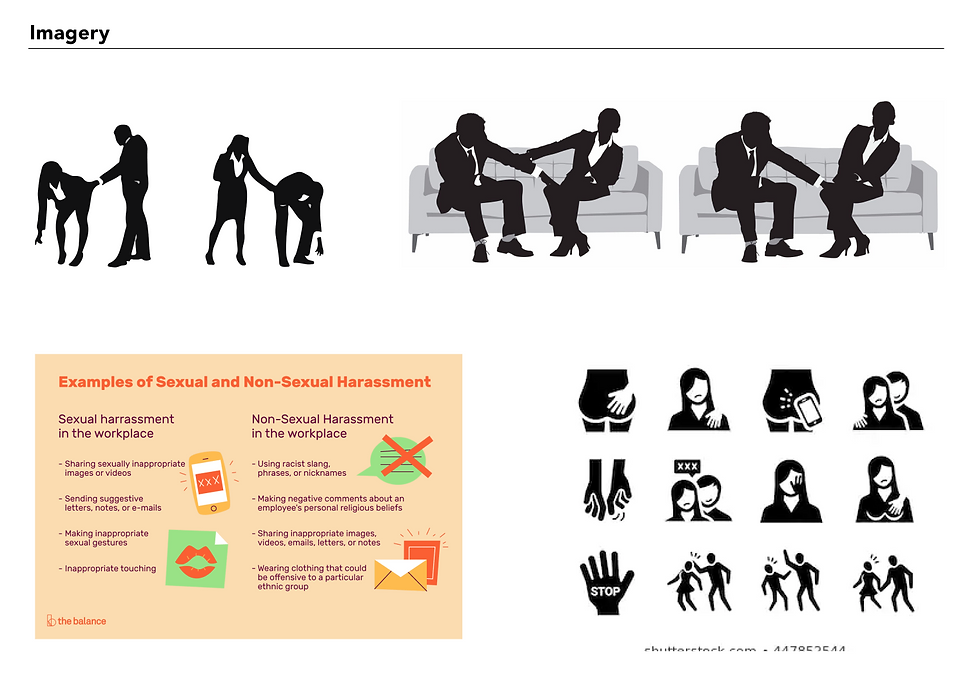
We were challenged with coming up with multiple different style guides and possible color combinations. We knew we wanted to highlight growth, hence the emphasis on the inclusion of green, but still wanted it to feel welcoming for the community.

PRototype
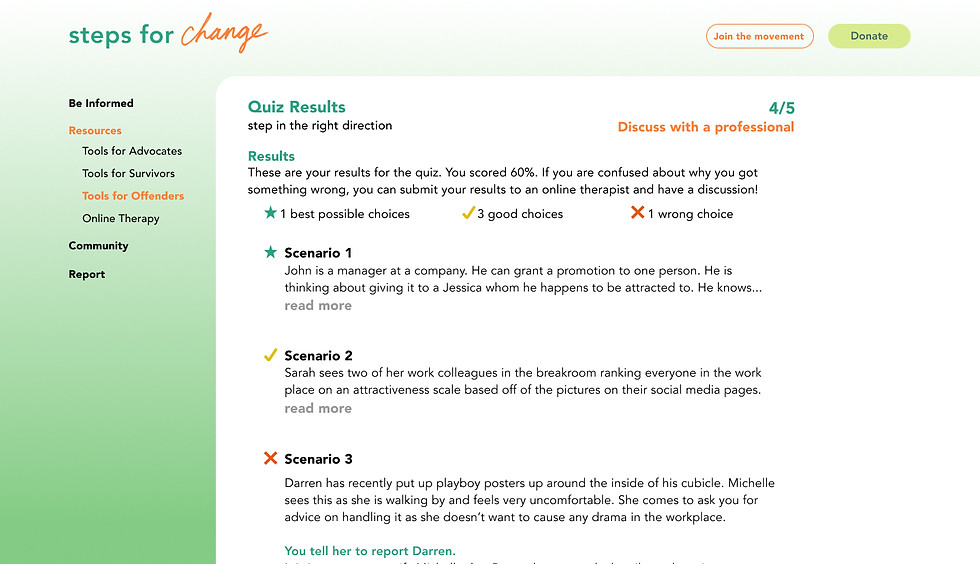
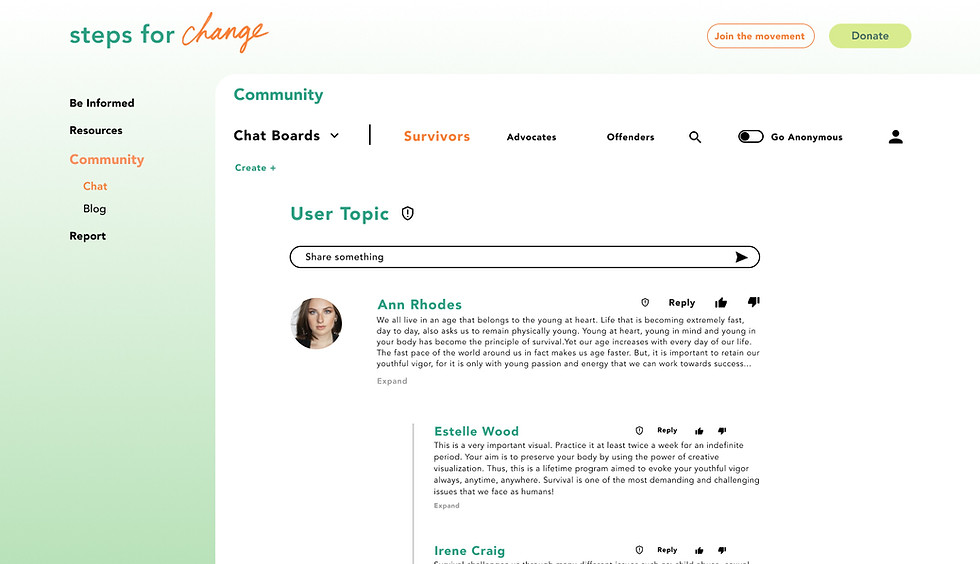
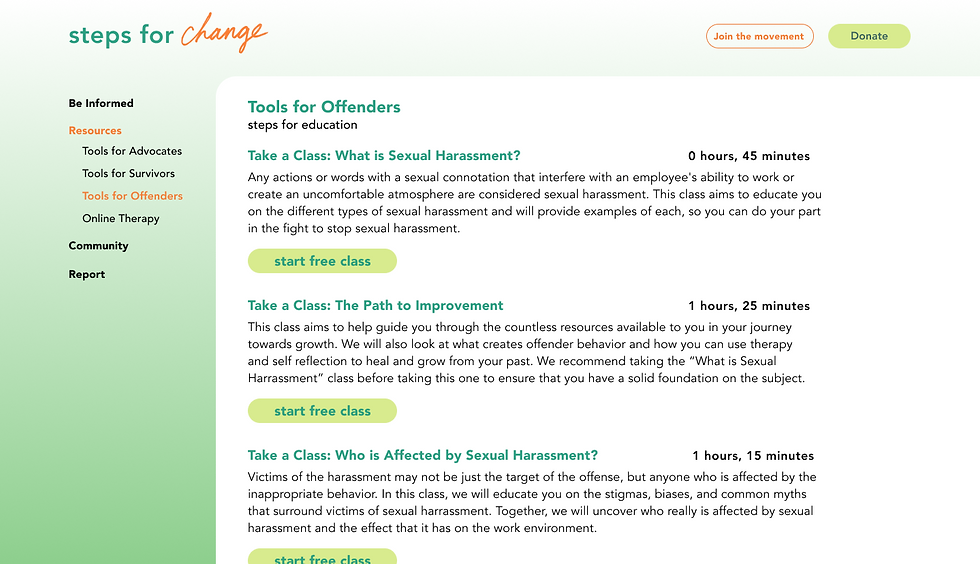
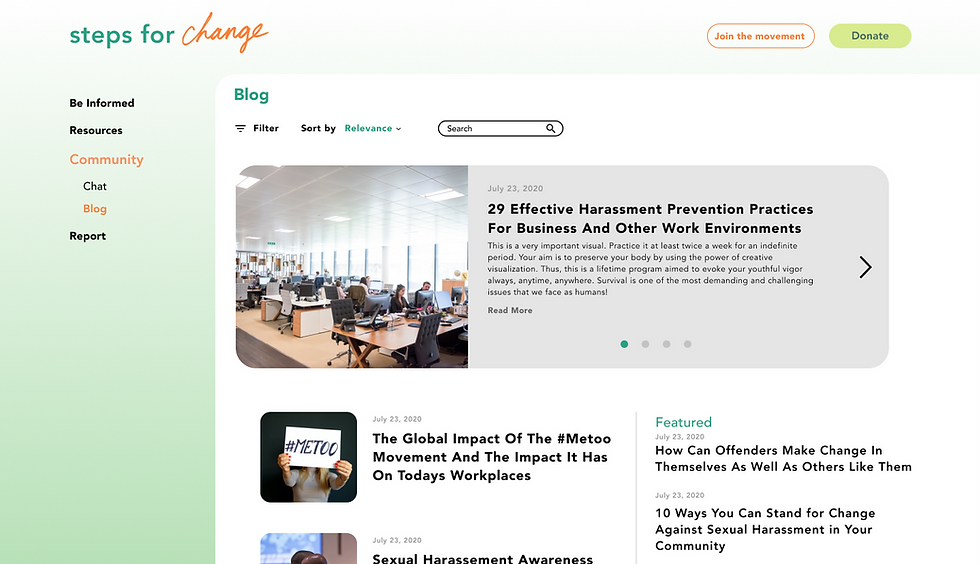
The high fidelity wireframes are linked and prototyped together to emulate how it will actually function in the product. We now take users through more extensive testing, asking them to go through specific flows without leading them in any direction to ensure that the design speaks for itself. After testing the mentioned user flows for a second time, a second and final iteration was created. The style guide has been implemented, filtering systems and privacy settings have been resolved on the community chat, the educating resources and quizzes have been populated with real content, and a blog has been added to the community section.
![[Internal Review] 2-Factor Authentication 12.7.22.png](https://static.wixstatic.com/media/0d89d0_c10700c57b8542ae906163c78066a184~mv2.png/v1/fill/w_980,h_705,al_c,q_90,usm_0.66_1.00_0.01,enc_avif,quality_auto/%5BInternal%20Review%5D%202-Factor%20Authentication%2012_7_22.png)


.png)




Next steps
01
Social Media interaction like ads, badges, stickers and more to expand the reach of the platform.
02
Fledging out other parts of the website such as the "Be Informed" section and "Report"
03
Further development of the Community page and how to deal with any flagged behavior
04
More comprehensive quizzes and classes to account for the multitude of scenarios including consent and coercion.
05
More user testing on our prototype
Final Thoughts
What did I learn?
This was the project that I learned how much I enjoyed the research process and found my stride as a researcher and information architect! Since this topic had so many factors to account for, mapping them out helped us consider all points of view and how it extended beyond the surface level of assistance. It was not enough to bring awareness to the issue, but to realize the lasting impact it has on the community and the healing process.
Working on this project also led me to my UX internship where my classmate recommended me to her boss for my skills in research and detail. Complex issues can be difficult to breach at first, but so rewarding to analyze. Being able to have confidence in my work has led me to so many opportunities and has only helped me advocate for my designs in rooms that I have been a part of.